Friday, December 2, 2011

Mystical Miscanti

More Andean flamingos flew away as the laughter of a couple of young ladies from my excursion group broke the silence. We were the first group there and as far as I could see, there were not that many (I reckon less than 50) flamingos to begin with and more left after we arrived. The Chaxa is a beautiful muddy lagoon in the Atacama desert where it is possible to spot a variety of Andean bird life. As I strolled back to the visitor center, another group just got in and I kind of felt sorry for them because most of the flamingos were gone by then. We had a light breakfast at the visitor center as our guide explained the ecosystem of the region. After that, we made our way to the highlight of the tour - the Miscanti and Miñiques. On our way, we stopped briefly to see the church of Socaire.

this would have been perfect if my camera came with wide-angle lens

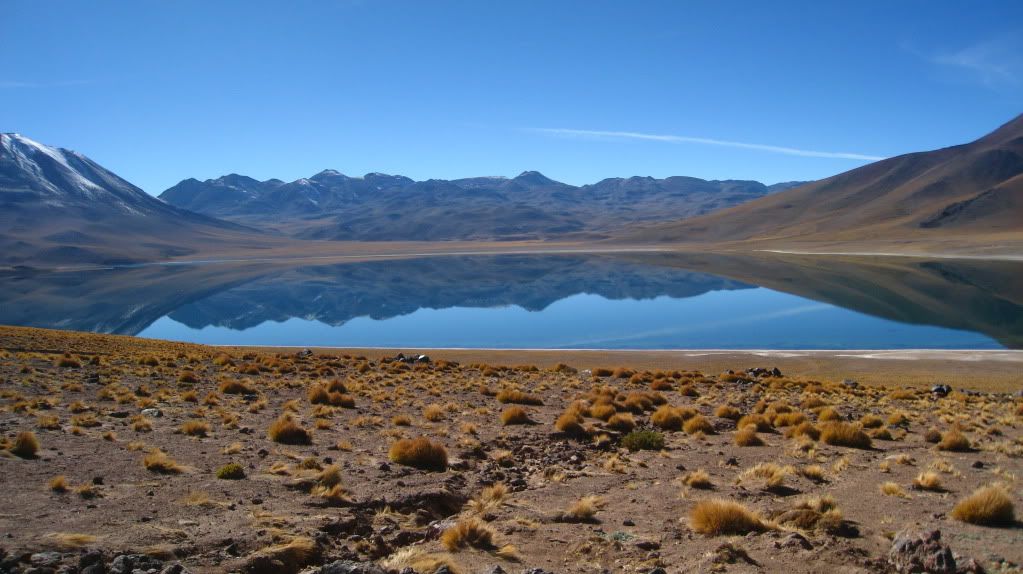
At a dizzying height of more than 4200m above sea level, nestled in the Andes lies another mezmerizing sight looking like an abstract painting. The two shimmering blue lagoons doted over by volcanos are simply gorgeous, and typical Andean scenery. The Miscanti is the bigger and more imposing of the two with visible snow on the volcano. Significantly smaller but just as alluring is the Miñiques. The lagoons are nesting sites for birds so we are not allowed to walk outside the designated area and path. This area is also a good place for spotting vicunas, Andean foxes and other wildlife.My Day 4 (final day in Atacama) tour concluded with a visit to the prehispanic village of Toconao - a sleepy town with a narrow plaza and a small church.

Tuesday, November 1, 2011

The Other Acropolis

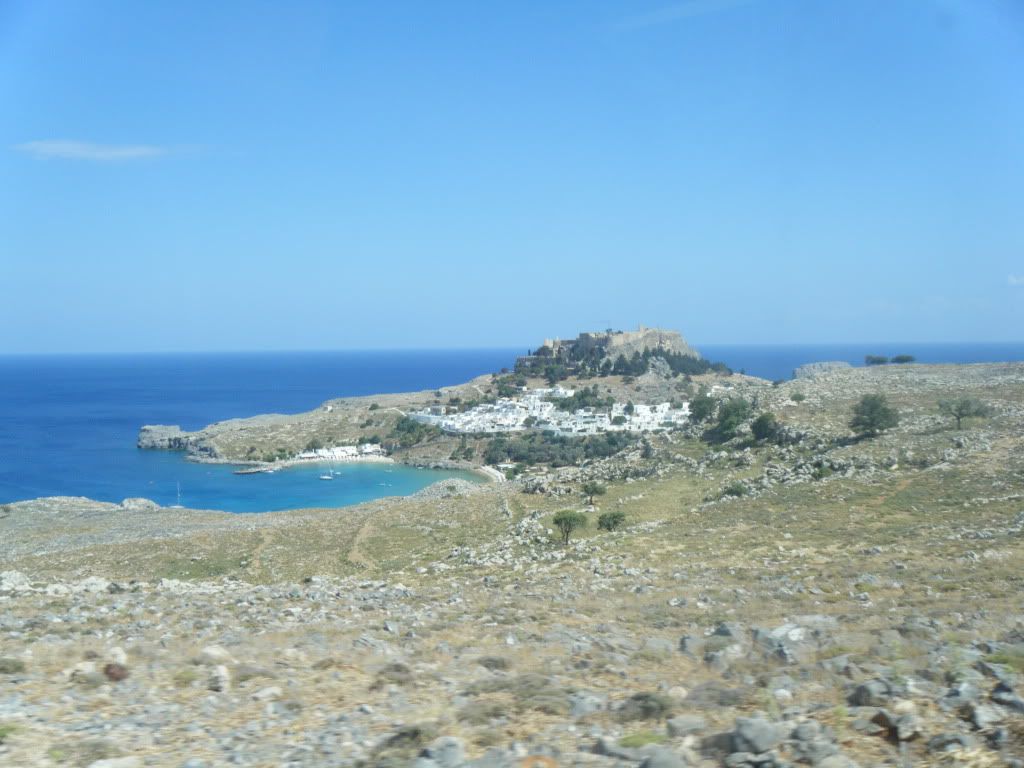
Recently a co-worker brought up the subject of traveling in Greece and she told us how her friend was looking forward to see the iconic Acropolis in Athens. It prompted me to write and share my photos on my visit to Rhodes (Rhodos) last year. Closer to Asia Minor than to the Greek mainland, Rhodes is the largest of the Dodecanese islands in terms of both land area and population. I stayed in a simple but lovely hostel at the heart of the medieval Old Town. It is one of the oldest inhabited medieval town in Europe and I easily spent an entire day visiting the sites around this ancient walled city. Another good way of seeing the Old City is just by walking around the outside. The fortification has a series of well-preserved gates and towers, and is remarkable as an example of a fully intact medieval structure.

acropolis of lindos pic taken from a bus
The town of Lindos, 45 km to the south of Rhodes town, is a beautiful little village of white cubist house and winding cobblestone streets at the foot of a vertical rock that is crowned by the Acropolis of Lindos. Before I read up for my visit to Greece, the only acropolis that I knew of was the iconic Acropolis of Athens. Having seen both, I think the Acropolis of Lindos is by far more picturesque from a distance and from the ruins itself because facing the sea, it offers dramatic views of the surrounding harbors and coastline. And on the day of my visit, it was for free admission to the public. I should be so lucky.

Saturday, October 1, 2011

Reflection

Suspended effortlessly and drifting in a lake surrounded by the mesmerizing Andes and desert, it almost felt like a dream. The Laguna Cejar is another quirky place in the middle of the Salar de Atacama with 40% salt content, so if you attempt to swim in it you will float, just like in the Dead Sea. It has actually a higher salt content than the Dead sea, which has about 33.7% salt. Oddly, the water was freezing near the surface but warm closer to the bottom and I later found out from my guide that it was due to the very high lithium contents. After rinsing off, we drove to nearby Ojos del Salar - two perfectly round sink holes with fresh water. It was too cold to swim by then but they made quite good photos with the Andes.

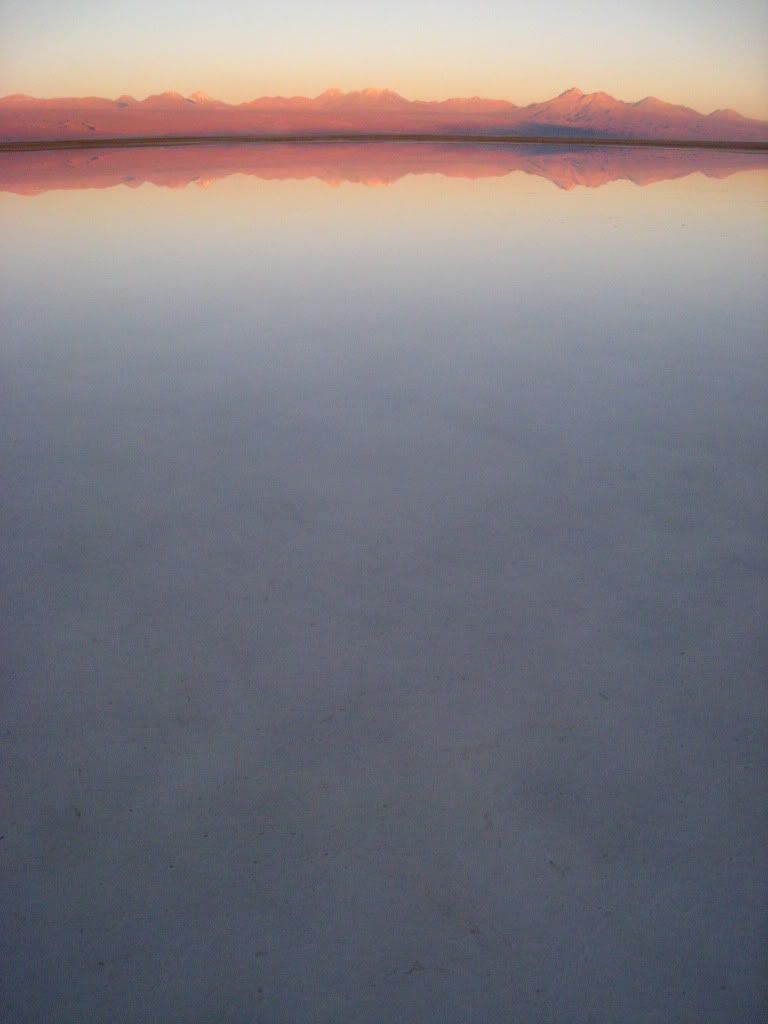
reflection

Saving the best for the last, the finale of my Atacama Day 3 tour was the surreal Tebenquiche salt lake. The water was perfectly still and just about a couple of inches high over the salt pan, creating one of the most breathtaking reflection scenery I have ever seen. Tourists amused themselves by posing on the salt flat to take reflecting photos and soon I found myself doing the same.  As the sun set, the mountain range incredibly shed shades of scarlet, gold, orange then purple producing spectacular reflection photography opportunities. What a place to drink pisco sour and watch the sun down... what a place.

Thursday, September 8, 2011

Me Encanta Buenos Aires

When traveling, I do not usually linger around the big cities or gateways longer than I need to, preferring to move on quickly. Since I live and work in a high-strung society and city most of my life, my trips are also in some way a retreat for me. So I was pleasantly surprised at how much I have taken to Buenos Aires when I visited South America for the first time. Despite being the capital federal of Argentina and second largest city in S America, it did not give me a big city feel that I tend to shun. I spent more than a week (non-consecutively) there and found the Porteños to be friendly, patient and laid back. BA was my point of entry and I stayed in San Telmo for one night before leaving for Salta early next morning. Although heavily jet-lagged, I nevertheless enjoyed a leisurely afternoon stroll at the famous Sunday flea market of San Telmo. What I find alluring about BA are - interesting as they may be - not the sights like La Boca or the Recoleta Cemetery but the different neighborhoods or barrios that do not really have any particular tourist attractions. Palermo is a residential barrio of parks filled with pines, palms, and willows, where families picnic on weekends and couples stroll at sunset.
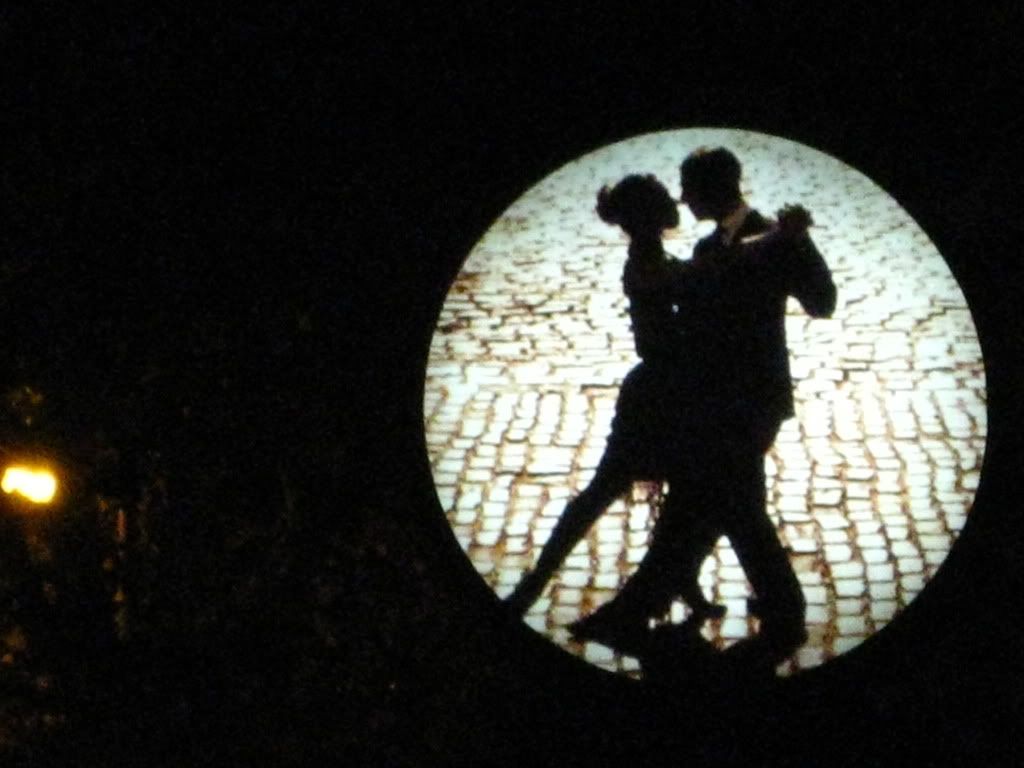
a lighted sign along avenida de mayo
One of its sub-barrios, Palermo Viejo is very popular among visitors for its bohemian vibe and trendy shops, cafes and restaurants. Which brings me to the subject of wine and dine in BA and it is what I like most about this city. In fact, my best meal of the trip was at a restaurant called La Cabrera in Palermo. The sirloin steak or bife de chorizo there was the best that I have ever had. It was Argentine beef grilled to perfection and served with various side dishes and sauces and the Malbec recommended by the helpful waiter was great with it. Best of all, unlike back home or most western industrialized countries, dining in style in BA is extremely good value. BA is not just great for the fine dining, I stumbled upon one those no-frills diners right next to the Retiro subte or subway station that served good parilla, wine and other local food. Another good find was a Peruvian restaurant Chan Chan in the Microcentro. The ceviche there was very popular and rightly so too. But the thing I found most irresistible was the chocolate blanco latte (white chocolate latte) at the Havanna cafe - divine... I was also lucky enough to be there during the Anniversary of the 1810 May Revolution and Paraguayan Bi-Centennial Independence. On both occasions, streets in the Microcentro were closed to traffic for a carnival filled with street performers and vendors. Hasta luego Buenos Aires.
Thursday, August 18, 2011

Geysers and Hot Springs

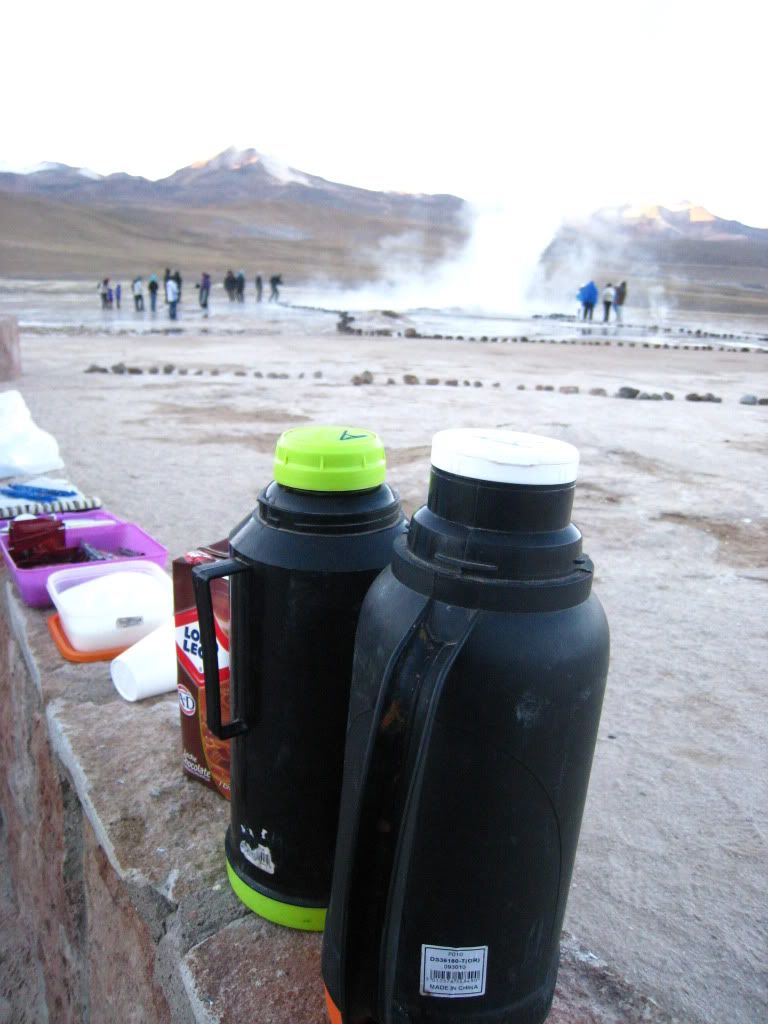
It was 4:30am and we were already on our way to the Tatio geysers - the highest (4200m) geothermal field in the world located 89km of San Pedro de Atacama in the Andes mountain range. We set off at this ungodly hour to catch the early morning fumaroles activity produced by the high temperatures of its watery craters. However, being at such a high altitude at such an early hour meant that it was terribly cold so I suffered a bit. The scenery here reminds me of how it must have been when the earth was first created. The ground hisses and belches out steam and strange odors. With all the steam around, coupled with the stark landscape in an arena of thermal pools and volcanoes, the atmosphere is rather bleak in the early hours.

breakfast at the geysers
After a light breakfast, we went for a dip in a thermal pool. I found it a little chilly but it was warmer in some places. The soak was really invigorating and we were ready to move on. We drove along the Putana River and passed by some stunningly beautiful river view especially where we stopped to take pictures. It was post-card perfect, teeming with bird life and majestic snow-capped mountains afar in the background. Next, we dropped by an Atacameno village, Machuca which is set in a ravine. The tour concluded with a quick stop at the cactus valley on the way back to San Pedro de Atacama.

Friday, July 29, 2011

Waka Waka - South Africa II

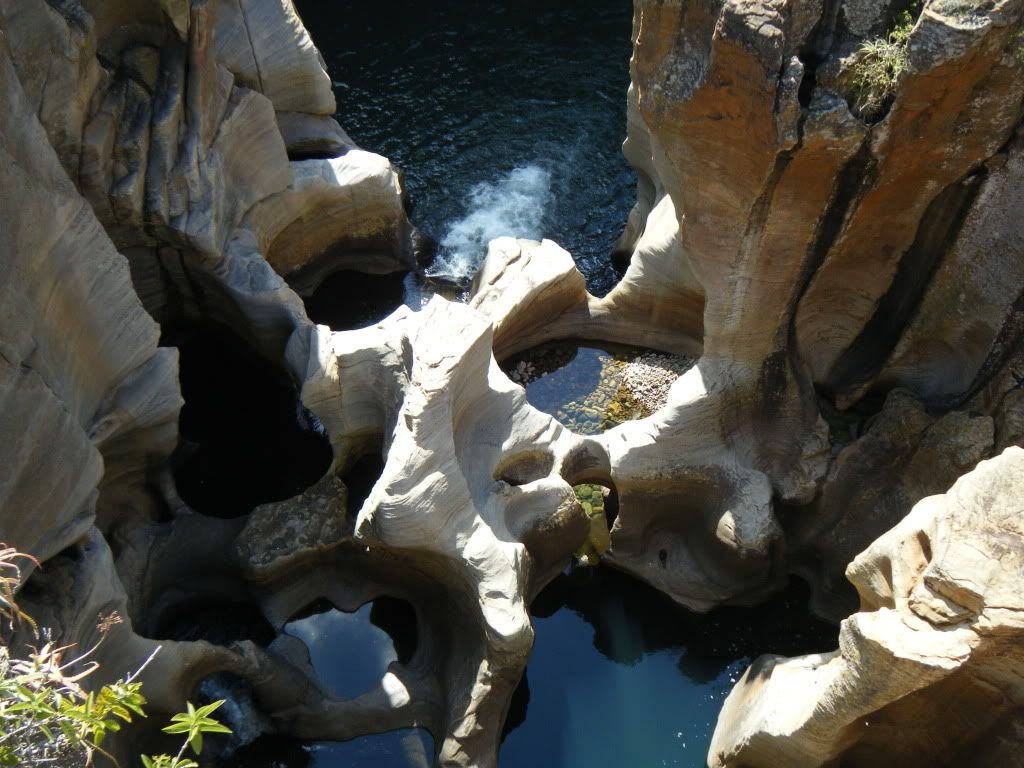
I flew back to Johannesburg from Livingstone after my Cape to Vic camping. Upon arrival, called and booked with one of those hotels near the airport that included free airport transfers. While waiting for my ride, I hastily made arrangement for a 4-day Kruger safari for the next day. Note that I managed these last-minute bookings outside the S African school holidays and high season. The safari pickup was at the crack of dawn taking the Panorama Route in Mpumalanga en route to Kruger passing by some of the most impressive landscape that S Africa have to offer. Along the well-beaten path is the Bourke’s Luck Potholes.These giant potholes have been carved over centuries by pebbles swirling around in pools where the Treur River plunges into the Blyde River. Not far from the potholes is the Drakensberg escarpment in Mpumalanga - God’s Window. Just one look down and you will begin to understand why it is called 'God's Window'. It was just getting dark by the time we got to Kruger. After camping for 20 days, I opted for more luxury with an accommodated safari and for the price, I found the standard of the lodge and meals rather high although it was located outside the national park.

bourke’s luck potholes
Kruger National Park is one of the largest (nearly 2 million hectares) game reserves in Africa. This world-renowned park also offers a wildlife experience and facilities that rank with the best in Africa. Even though it was the fourth game reserve or national park that I have visited on that trip - Etosha, Chobe and Okavango Delta before that - I was still excited about going on game drives like it was my first time. You never know what you are going to see or happen on a game viewing activity so it is a different experience every time. It was also in Kruger that I finally saw a leopard - the last of the Big-Five that eluded me up to that point - albeit for only 2 seconds.

Friday, July 15, 2011

An Experience Outside This World

The other day when a friend asked what was the highlight of my Argentina/Chile trip, I replied 'the Atacama' right away without hesitation. The Atacama desert is the top attraction in northern Chile and it is easy to see why. This otherworldly land is composed mainly of salt flats and sand. The desert is believed to be the driest on earth with some areas having never received even a drop of rainfall. In the middle of the desert at about 2400m elevation, the village of San Pedro de Atacama is the base for most visitors. Most travel agencies in San Pedro offer similar packages and I did four of the most popular (half) day tours here. I will publish each of them in separate posts.

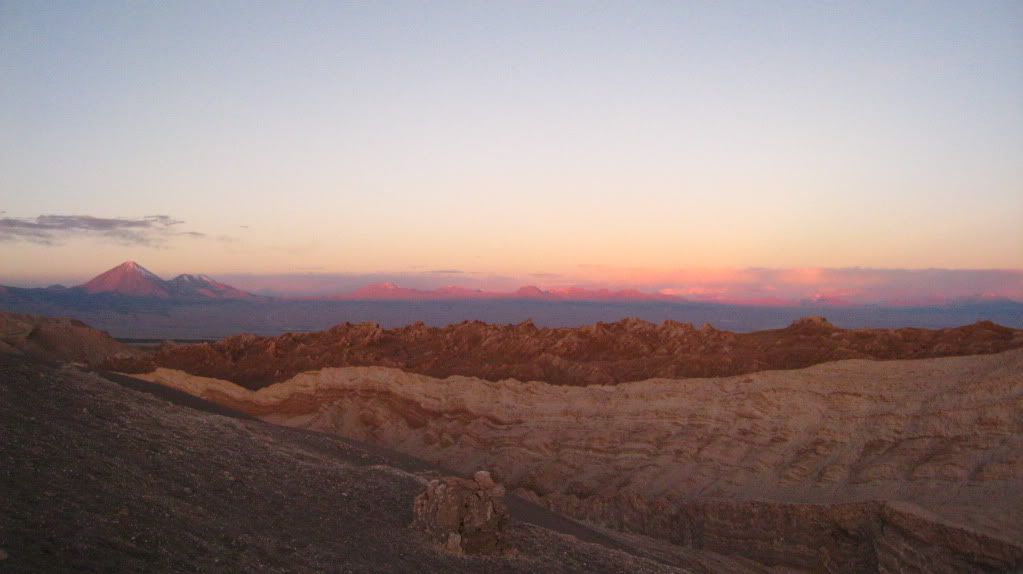
sunset at moon valley

It was a tough choice but I picked the Moon Valley (Valle de la Luna) tour for Day 1. The tour began at three in the afternoon and headed first to the Death Valley (Valle de la Muerte). The Cordillera de Sal (Salt Mountains) with a variety of natural sculptures and colorations by the mineral diversity and spectacular volcanoes including the Licancabur which could be seen from hundreds of kilometers away in the background. Next, a short drive brought us to an ancient salt river bed and caves. We walked through the river bed and some caves for only about 300m before rushing off to Moon Valley for the sunset. On the way, we made a quick stop to see some strange rock and salt formation known as Las Tres Marias. The Moon Valley make for a dramatic setting to watch the sunset. To one side, a large rock formation shaped by the wind to form a valley with panoramic vista. To the other, the severe peak of Mount Licancabur shed shades of gold and orange as the sun sets. The pamphlet that I picked up from the park office read 'An Experience Outside this World' - considering the Atacama is so Mars-like that NASA frequently uses it as a test region for their personnel and equipment, that statement is not far-off.

Friday, July 1, 2011

First Peek at the Cataratas

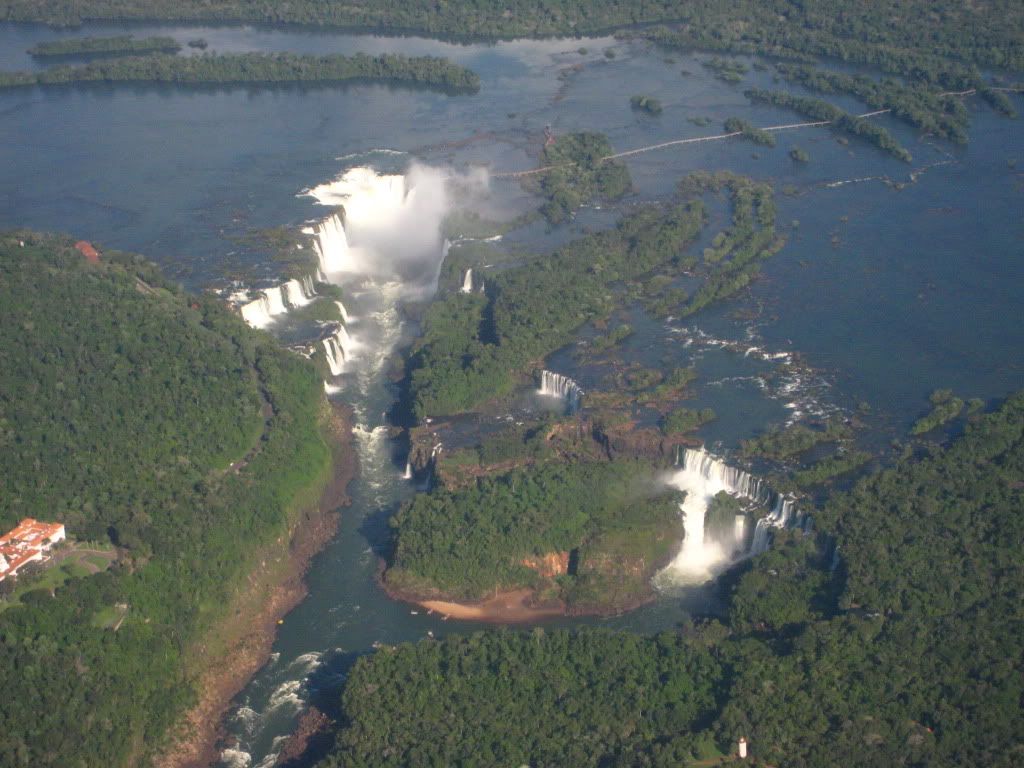
During my flight to Puerto Iguazu from Salta, I was treated to an unforgettable spectacle. As the plane began to descend, I looked out the window hoping to catch a glimpse of the Iguazu Falls or Cataratas as the locals called it. I saw what I assumed was the River Iguazu so I had my camera ready but after several minutes, no sight of the Cataratas. Just as I thought it was not going to happen, the pilot announced that we would be flying pass the falls in a minute. It was my lucky day indeed - not only was I seated on the side with the view, I also had the window seat that was unobstructed by the aircraft wing too.

an unforgettable spectacle

The pictures in this post are understandably not of the highest quality but I like that because of the height that they were taken from, they are still quite awesome with the overview of not only the entire falls but also the surrounding jungle. Some of the details like the bridge leading to the Devil's Throat (Argentina side) and the Hotel Das Cataratas in Brazil are apparent but to find the Devil's Throat in Brazil, you may have to look a little more carefully. It was a perfect way to arrive and I cannot think of a better way to start off my visit to the Cataratas.

Related Posts Plugin for WordPress, Blogger...