 |
| bourke’s luck potholes |
Friday, July 29, 2011
Waka Waka - South Africa II
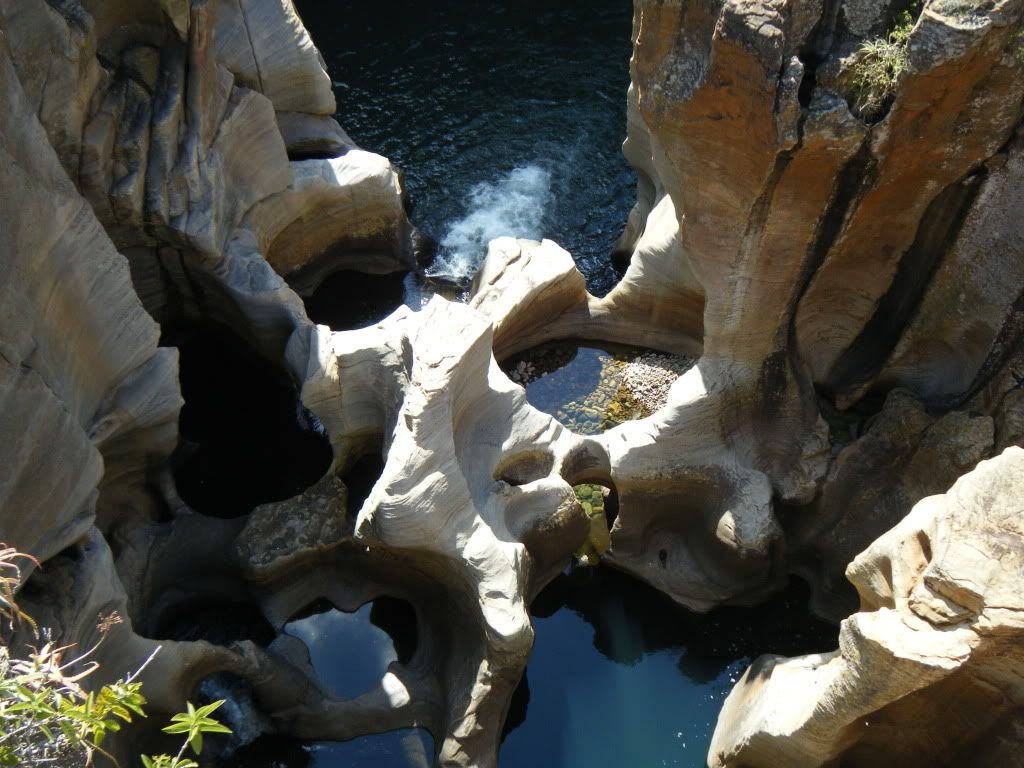
I flew back to Johannesburg from Livingstone after my Cape to Vic camping. Upon arrival, called and booked with one of those hotels near the airport that included free airport transfers. While waiting for my ride, I hastily made arrangement for a 4-day Kruger safari for the next day. Note that I managed these last-minute bookings outside the S African school holidays and high season. The safari pickup was at the crack of dawn taking the Panorama Route in Mpumalanga en route to Kruger passing by some of the most impressive landscape that S Africa have to offer. Along the well-beaten path is the Bourke’s Luck Potholes.These giant potholes have been carved over centuries by pebbles swirling around in pools where the Treur River plunges into the Blyde River. Not far from the potholes is the Drakensberg escarpment in Mpumalanga - God’s Window. Just one look down and you will begin to understand why it is called 'God's Window'. It was just getting dark by the time we got to Kruger. After camping for 20 days, I opted for more luxury with an accommodated safari and for the price, I found the standard of the lodge and meals rather high although it was located outside the national park.
Kruger National Park is one of the largest (nearly 2 million hectares) game reserves in Africa. This world-renowned park also offers a wildlife experience and facilities that rank with the best in Africa. Even though it was the fourth game reserve or national park that I have visited on that trip - Etosha, Chobe and Okavango Delta before that - I was still excited about going on game drives like it was my first time. You never know what you are going to see or happen on a game viewing activity so it is a different experience every time. It was also in Kruger that I finally saw a leopard - the last of the Big-Five that eluded me up to that point - albeit for only 2 seconds.

Friday, July 15, 2011
An Experience Outside This World
The other day when a friend asked what was the highlight of my Argentina/Chile trip, I replied 'the Atacama' right away without hesitation. The Atacama desert is the top attraction in northern Chile and it is easy to see why. This otherworldly land is composed mainly of salt flats and sand. The desert is believed to be the driest on earth with some areas having never received even a drop of rainfall. In the middle of the desert at about 2400m elevation, the village of San Pedro de Atacama is the base for most visitors. Most travel agencies in San Pedro offer similar packages and I did four of the most popular (half) day tours here. I will publish each of them in separate posts.
 |
| sunset at moon valley |
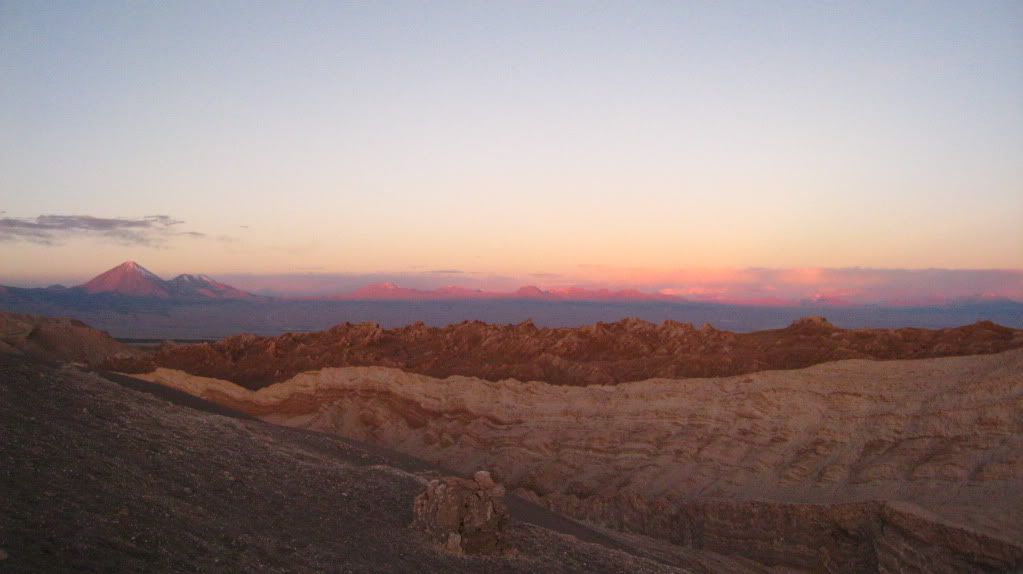
It was a tough choice but I picked the Moon Valley (Valle de la Luna) tour for Day 1. The tour began at three in the afternoon and headed first to the Death Valley (Valle de la Muerte). The Cordillera de Sal (Salt Mountains) with a variety of natural sculptures and colorations by the mineral diversity and spectacular volcanoes including the Licancabur which could be seen from hundreds of kilometers away in the background. Next, a short drive brought us to an ancient salt river bed and caves. We walked through the river bed and some caves for only about 300m before rushing off to Moon Valley for the sunset. On the way, we made a quick stop to see some strange rock and salt formation known as Las Tres Marias. The Moon Valley make for a dramatic setting to watch the sunset. To one side, a large rock formation shaped by the wind to form a valley with panoramic vista. To the other, the severe peak of Mount Licancabur shed shades of gold and orange as the sun sets. The pamphlet that I picked up from the park office read 'An Experience Outside this World' - considering the Atacama is so Mars-like that NASA frequently uses it as a test region for their personnel and equipment, that statement is not far-off.
Friday, July 1, 2011
First Peek at the Cataratas
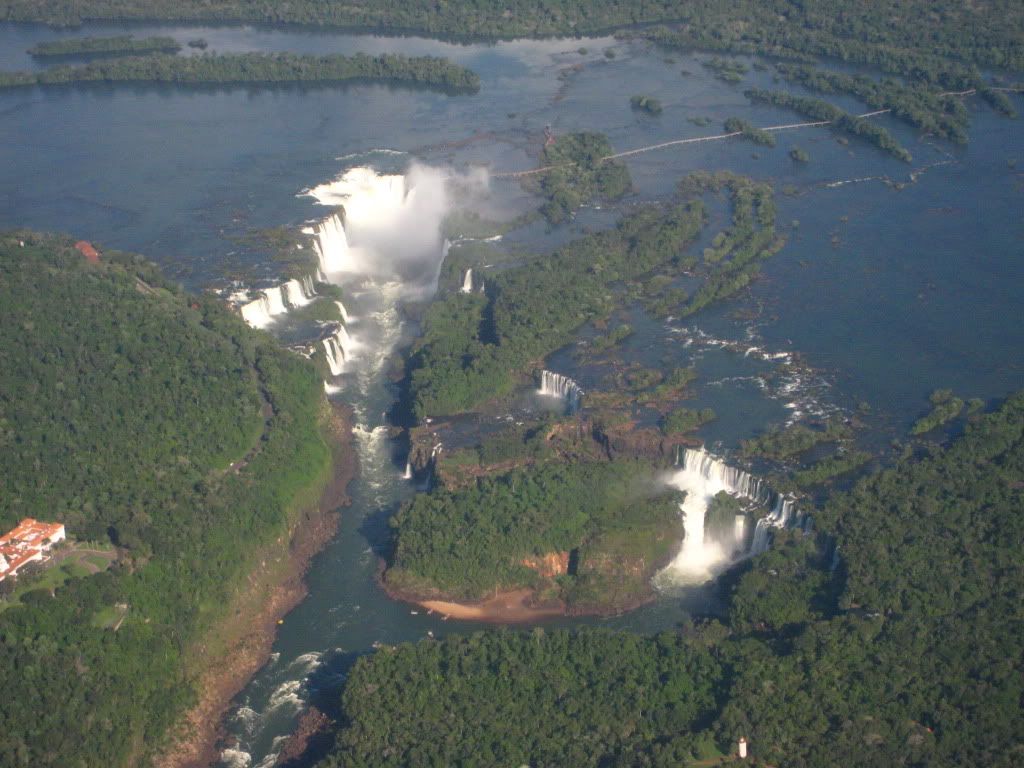
During my flight to Puerto Iguazu from Salta, I was treated to an unforgettable spectacle. As the plane began to descend, I looked out the window hoping to catch a glimpse of the Iguazu Falls or Cataratas as the locals called it. I saw what I assumed was the River Iguazu so I had my camera ready but after several minutes, no sight of the Cataratas. Just as I thought it was not going to happen, the pilot announced that we would be flying pass the falls in a minute. It was my lucky day indeed - not only was I seated on the side with the view, I also had the window seat that was unobstructed by the aircraft wing too.
The pictures in this post are understandably not of the highest quality but I like that because of the height that they were taken from, they are still quite awesome with the overview of not only the entire falls but also the surrounding jungle. Some of the details like the bridge leading to the Devil's Throat (Argentina side) and the Hotel Das Cataratas in Brazil are apparent but to find the Devil's Throat in Brazil, you may have to look a little more carefully. It was a perfect way to arrive and I cannot think of a better way to start off my visit to the Cataratas.
 |
| an unforgettable spectacle |
The pictures in this post are understandably not of the highest quality but I like that because of the height that they were taken from, they are still quite awesome with the overview of not only the entire falls but also the surrounding jungle. Some of the details like the bridge leading to the Devil's Throat (Argentina side) and the Hotel Das Cataratas in Brazil are apparent but to find the Devil's Throat in Brazil, you may have to look a little more carefully. It was a perfect way to arrive and I cannot think of a better way to start off my visit to the Cataratas.
Saturday, June 18, 2011
La Boca
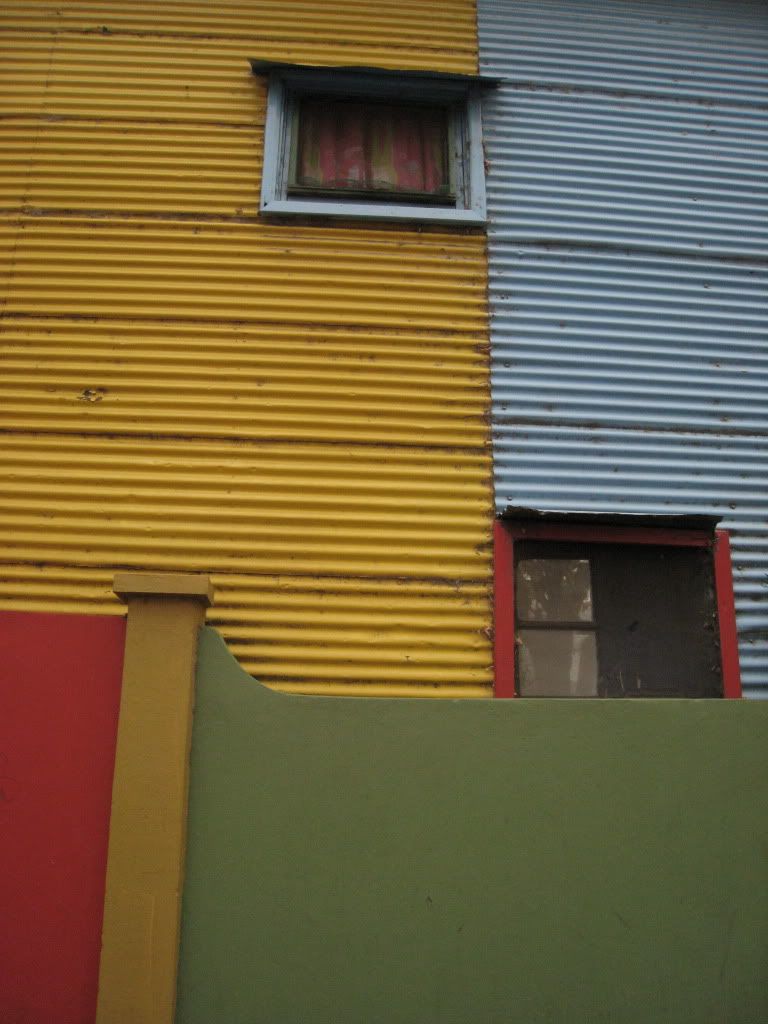
While in Buenos Aires recently, I visited its most colorful, interesting and authentic neighborhood (barrio). La Boca literally means 'the mouth' in Spanish, as the barrio sits at the mouth of the river Riachuelo. In the mid-19th century, it was home to Italian immigrants who worked in meat-packing plants and warehouses. They used leftover paint to color the corrugated metal they used for building their houses. Today it is partly an artist colony and mostly a working-class barrio. The most famous street in La Boca is El Caminito and is the center of tourist activity with artists showing off their work and street tango performers. I particularly enjoyed taking a lot of pictures of the buildings and streets in this area.
As a massive football fan, no visit to La Boca was complete for me without going to La Bombonera (the Chocolate Box) - home to Boca Juniors, one of the biggest football teams in Argentina. Just four blocks from El Caminito, it is worth checking the football type graffiti near and all around it. Because of my somewhat tight travel schedule, I was unable to catch a game in Buenos Aires so a stadium tour of La Bombonera was the next best thing. For a club of Boca Juniors' stature, I found the stadium rather small and the facilities modest but what it lack in size, it more than make up with its character and ambiance. It is uniquely shaped (D-shaped) with yellow-blue design which are the official colors of the home team. I think first-time Buenos Aires visitors should definitely make an effort to come see La Boca. A word of caution though, visit only in the day and stick to El Caminito and the streets around it because the rest of the barrio is not considered safe.
 |
| colors of la boca |
Sunday, June 5, 2011
Epic Bus Journey
You may be wondering why I have chosen to start off by writing about some bus rides on my recent trip to Argentina and Chile. After all, there are no shortage of surreal or awe-inspiring places to share with you. Although bus travel can be an excellent way of seeing new places, I generally do not look forward to it especially if it starts early in the morning and takes all day. But the return bus ride (about 10 hrs each way) between Salta, Argentina and San Pedro de Atacama, Chile was to put it mildly, one heck of a ride.
Due to the effects of fatigue and traveling in varying altitudes, I was not able to fully take in or appreciate the Salta-Atacama leg. But in the return, I was much better conditioned and managed to stay awake for the entire journey to witness some of the most breathtaking landscape that I have ever seen. Best of all was probably between the Chilean and Argentine border controls at the beginning of the ride. There were oases of lakes and greenery with birds and wildlife, salt pans and snow-capped mountains for background in this barren land. In Argentina, we passed long narrow valleys flanked by high mountain ranges and as it got lusher, it turned into miles of cactus valleys. But the one that got many passengers excited was the Salina Grande or salt flat in Jujuy.
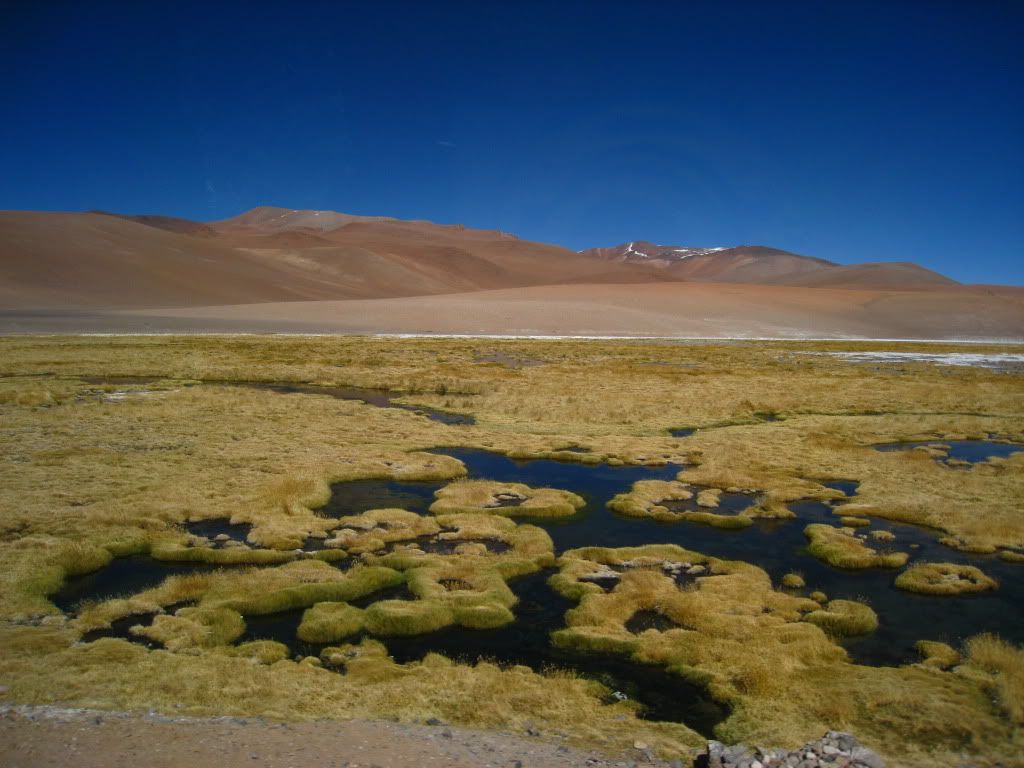 |
| an oasis near the chilean border control |
Due to the effects of fatigue and traveling in varying altitudes, I was not able to fully take in or appreciate the Salta-Atacama leg. But in the return, I was much better conditioned and managed to stay awake for the entire journey to witness some of the most breathtaking landscape that I have ever seen. Best of all was probably between the Chilean and Argentine border controls at the beginning of the ride. There were oases of lakes and greenery with birds and wildlife, salt pans and snow-capped mountains for background in this barren land. In Argentina, we passed long narrow valleys flanked by high mountain ranges and as it got lusher, it turned into miles of cactus valleys. But the one that got many passengers excited was the Salina Grande or salt flat in Jujuy.
Sunday, May 1, 2011
Waka Waka - South Africa
Shortly after we had entered Namibia overland, my new Korean friend turned to me, 'Hey, now it's really starting to feel like Africa.' I could not have agreed with him more. After spending a couple of days in Cape Town and a few more camping in the Cederberg Mountain Region and Gariep (Orange) River, it was the first time on the trip that I felt the real sense of Africa.
Do not get me wrong, I like South Africa. It is without doubt, a premier travel destination in Africa with some amazingly beautiful scenery and top-class game parks. It is also an ideal jumping-off point to the rest of the Southern African nations. But the further up north I went, the more it felt like the 'real Africa' to me. I think it was partly due to the changes in the terrain and color of the land as we traveled north and the frequent sightings of wildlife at places where I least expected to in some of the other countries. It was common to see springboks and to a lesser extent, giraffes, ostriches, oryxes and other antelopes all over Namibia. In Botswana and Zimbabwe (near Victoria Falls) elephants were surprisingly spotted on and off the paved roads. I even saw an elephant one evening in the middle of the town of Victoria Falls. In S Africa, outside the parks and game reserve, wildlife - with the exception of baboons - were not seen.
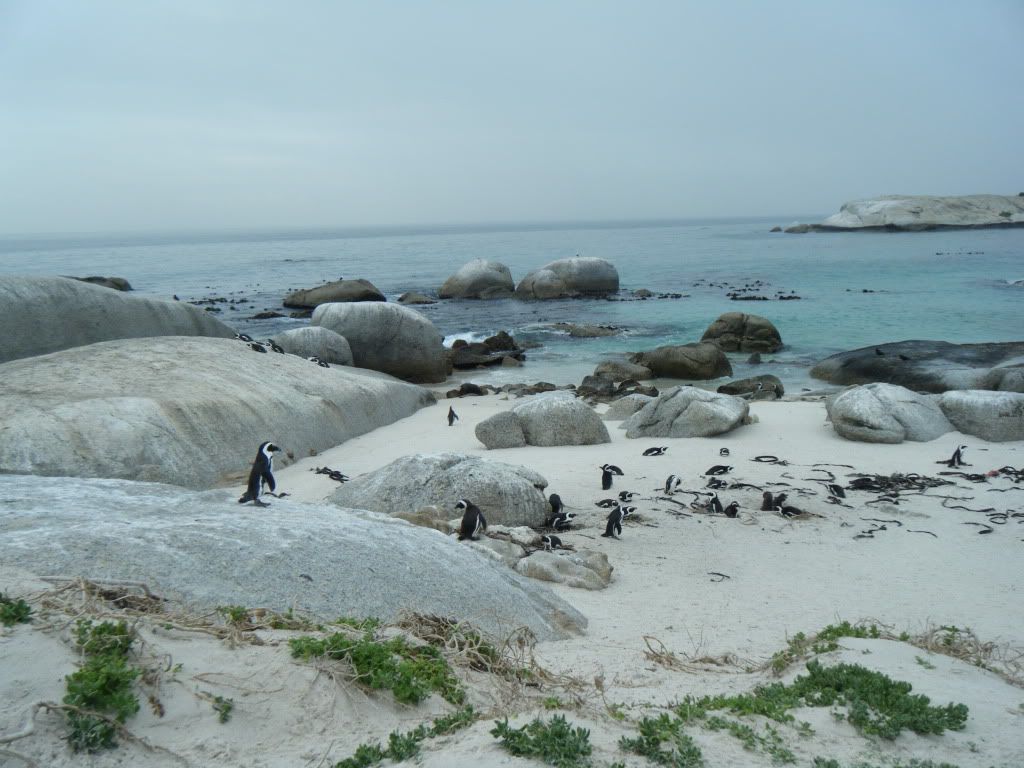 |
| boulders beach |
Do not get me wrong, I like South Africa. It is without doubt, a premier travel destination in Africa with some amazingly beautiful scenery and top-class game parks. It is also an ideal jumping-off point to the rest of the Southern African nations. But the further up north I went, the more it felt like the 'real Africa' to me. I think it was partly due to the changes in the terrain and color of the land as we traveled north and the frequent sightings of wildlife at places where I least expected to in some of the other countries. It was common to see springboks and to a lesser extent, giraffes, ostriches, oryxes and other antelopes all over Namibia. In Botswana and Zimbabwe (near Victoria Falls) elephants were surprisingly spotted on and off the paved roads. I even saw an elephant one evening in the middle of the town of Victoria Falls. In S Africa, outside the parks and game reserve, wildlife - with the exception of baboons - were not seen.
Friday, April 1, 2011
3D2N at the Delta
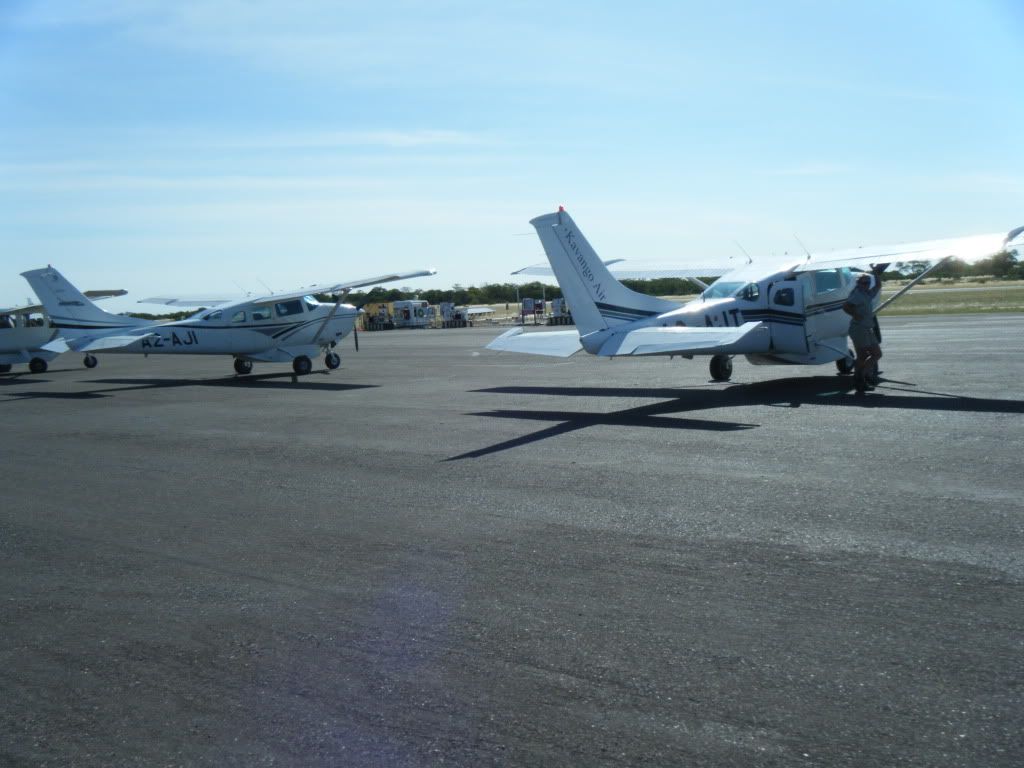 |
| where's my ride? |
Wednesday, March 2, 2011
A Lesser Known Greek Island II
On my second day in Folegandros, I took the early bus to Ano Meria - a scatter community of small farms and houses that stretches for several kilometers. This is traditional island life, untouched by tourism and life quietly wanders off sideways. Using the paved road, I walked back to the Chora and was rewarded with some excellent cliff top views of the coastline.
Once back at the Chora, it was lunch before heading out to the Panagia. A steep path leads up to the church of Virgin Panagia, which sits perched on a dramatic cliff top above the town. I did not see anyone on my way up so unsurprisingly, there was nobody in the vicinity of the church. As I wandered around, I discovered that parts of the church building structure were actually steps, enabling one to easily climb to the top of the church's dome roof. At the top, I felt a certain calm and peace and the view of the Chora and surroundings was quite breathtaking.
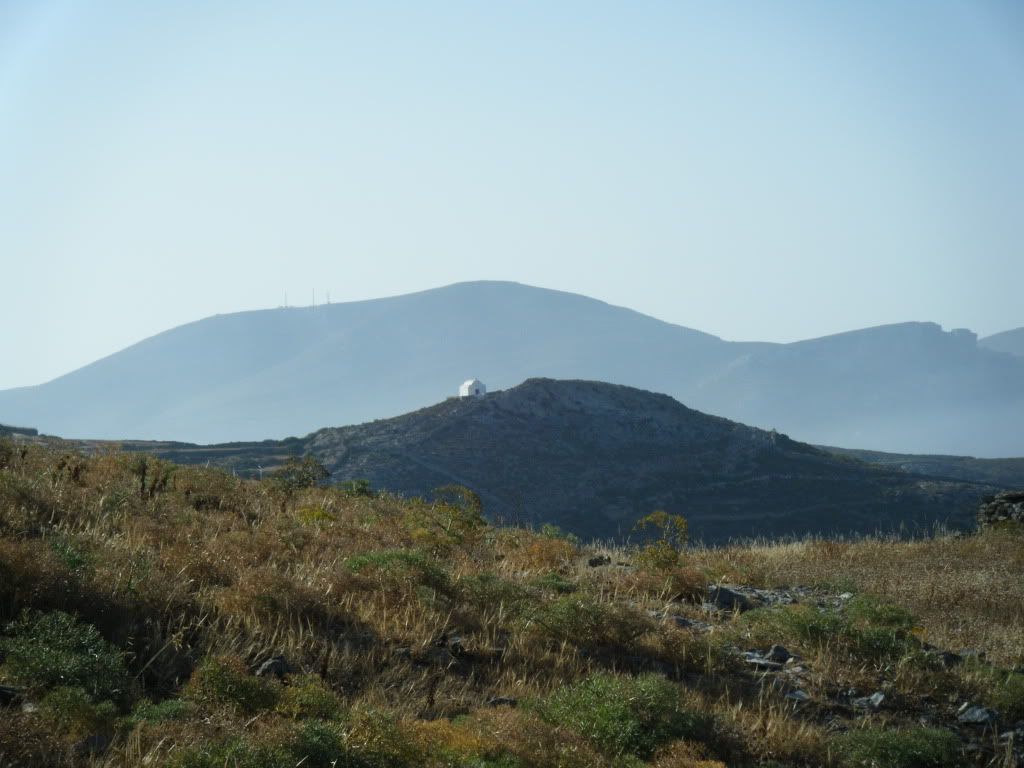 |
| view from ano meria |
Once back at the Chora, it was lunch before heading out to the Panagia. A steep path leads up to the church of Virgin Panagia, which sits perched on a dramatic cliff top above the town. I did not see anyone on my way up so unsurprisingly, there was nobody in the vicinity of the church. As I wandered around, I discovered that parts of the church building structure were actually steps, enabling one to easily climb to the top of the church's dome roof. At the top, I felt a certain calm and peace and the view of the Chora and surroundings was quite breathtaking.
Subscribe to:
Posts (Atom)
