 |
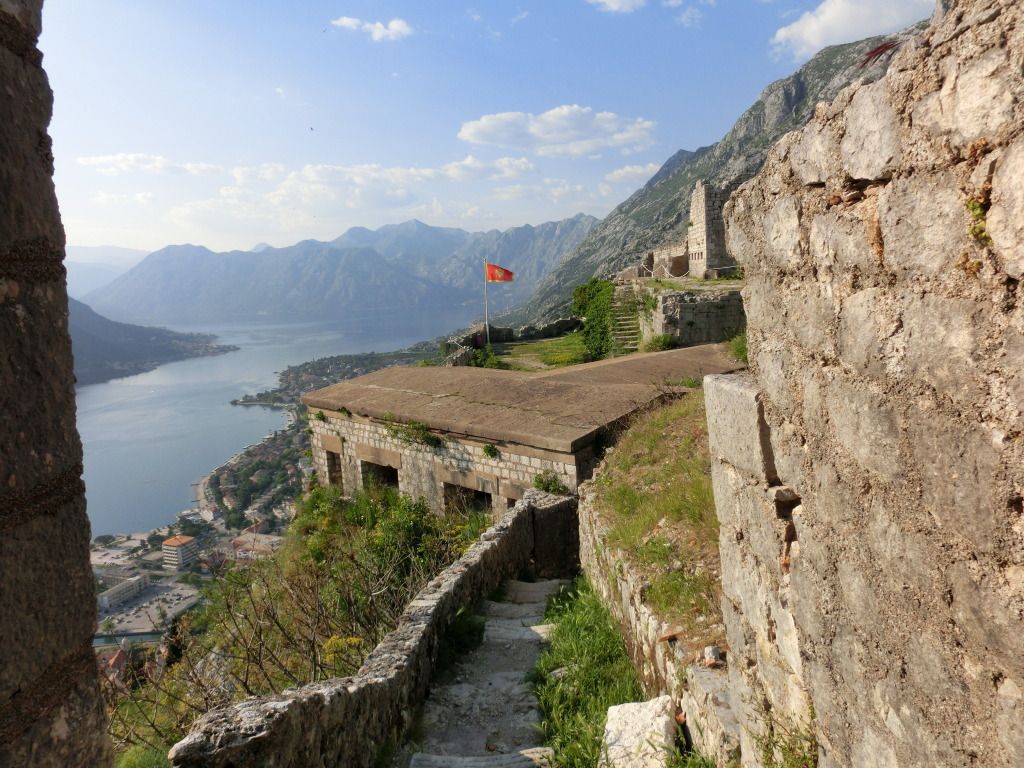
| view from the st john fortress in kotor |
Thursday, March 21, 2013
Dubrovnik vs Kotor - The Balkans (D11/12)

Tuesday, February 12, 2013
An Inconvenient Storm - East Africa (D3/4)
Not long after we had left camp for a full day game drive, we saw a pride of lions - 2 adult females and 3 big cubs all resting under trees. We were game driving to Beho Beho hot springs on my third day in Selous. We passed a uniquely picturesque lake filled with birdlife and in the lake stood trees - dead trees. The trees died when the area became flooded but what I found intriguing was that they did not just rot away but remained standing. Just like if the Dead Vlei became flooded again. On we went and another pride of lions and this time 2 males and a female. Unlike in Etosha and Kruger, off-road driving is allowed here so we were able to get really close to the lions although other more skittish animals will simply run away. It seemed like the heat was getting to the lions especially the big males as they panted heavily even when inactive. The manes on the males were also noticeably thinner and that might have something to do with the climate as well. The guide located a kill (wildebeest) hidden in the bush not far away from the lions. As we drove toward Beho Beho, the concentration of game quickly dried up and for a while, even the impalas went missing. Then we arrived at Lake Tagalala, a bird paradise with Marabou Storks, White Pelicans, Pied Kingfisher and others. Along the shore, crocodiles were rushing into the lake to join the hippos as our jeep approached them. We stopped for a picnic lunch in this wild setting - just us with no other vehicle in sight by the lake. What a moment in safari... After lunch, we left Lake Tagalala and drove to the hot spring at the foot of Beho Beho. Apparently I had chosen to visit the hot spring on the hottest day in recent times but I would not leave without taking a dip. It felt lukewarm but the water from the small falls was a bit warmer. My guide and driver joined me in the hot spring for an enjoyable but quick dip. This area in Selous is really isolated and in fact we had not met another vehicle since we left the lions sighting in the morning. On the way back to camp, I was lucky enough to witness the most amazing spectacle of large flocks of Red-Billed Quelea while passing an open area. They formed dark fast moving clouds and dodging and weaving around trees, appeared upwards off the ground as if from nowhere.

'Let's go that way,' our guide pointed to the direction of the hyenas. I thought that was an absurd thing to do in a game walk. We had earlier seen several hyenas about 300 meters away and they disappeared behind the bush. Game walks can be really interesting and this morning, I picked up on the characteristic of various animals (giraffe, elephant and hyena) dung, footprints (hippo) and smaller animals and insects (buffalo weaver and lion ant). And thankfully we did not run into those hyenas again for the rest of the walk. The early morning game walk ended quite early so the camp manager had arranged for me to do a short game drive after breakfast. Here in Lake Manze Camp, they are really accommodating and flexible about the activities and the quality of food, service and accommodation have far exceeded my expectations. Because it was not the peak season, I was given exclusive use of the vehicle for two days. The late morning game drive however was a shared drive but it was nice to have others around too. First notable encounter was 2 hyenas sleeping under some fallen trees. All of a sudden, one of them ran out and we followed it and saw it chewing on an impala leg behind a tree before running away. I kind of prefer watching hyenas from the safety of a vehicle. We drove around some more without seeing much until we found vultures feeding on an impala carcass. The carcass looked fresh and it probably died of natural causes. Back at the camp, I was game watching from my tent porch after lunch when I noticed dark clouds ominously appearing. It was supposed to be the beginning of the wet season but the for the past two days, the weather had been great. But now a storm was brewing as I eagerly awaited for the final game viewing activity in Selous. I was saving the sunset motorboat safari not only because it was the most popular activity but also the National Parks that I was going to after that did not have boat/river activity. On the way to the nearby starting point, it began to pour and it was absolutely torrential. I was quickly drenched at the back of the open sided safari vehicle. When we got there, I thought the boatman was going to call it off but he waved me over instead. I was putting on the raincoat handed to me in the boat when we were devastated by a strongest gust of wind imaginable, smashing tree branches, pebbles, sand and other debris at us and only the rope tied to a tree kept us by the river bank. End of my motorboat safari.

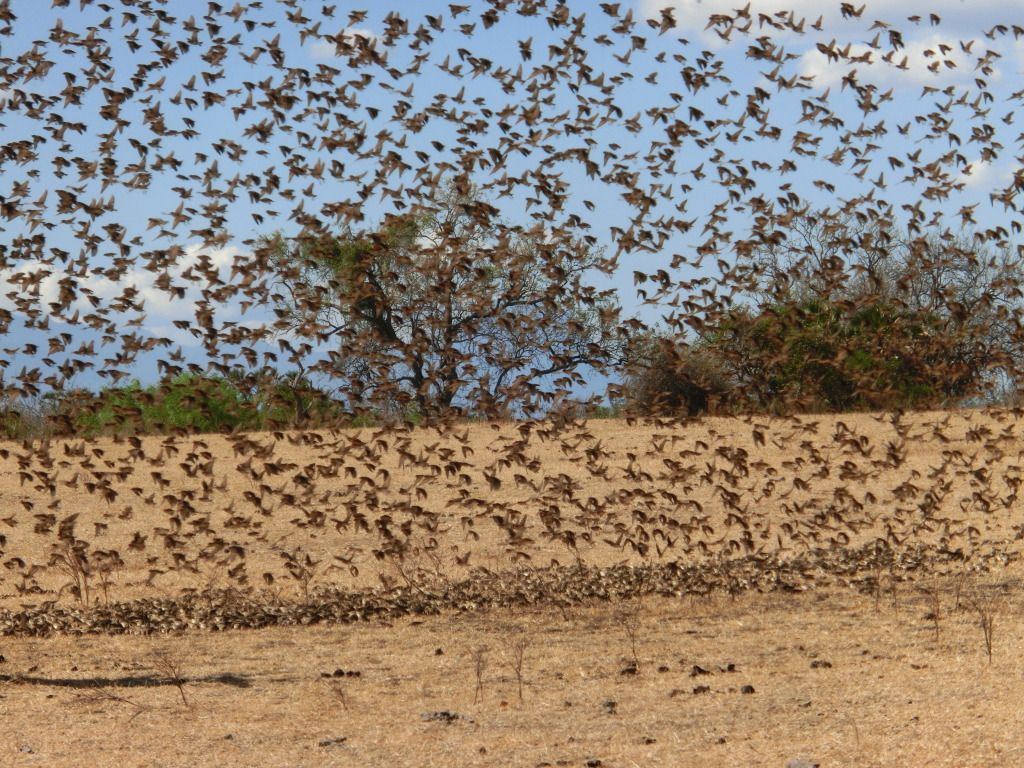 |
| nature marvel - flock of red-billed quelea |
Saturday, January 5, 2013
Got Gregada? - The Balkans (D8/9/10)
Back to Split again for a catarmaran connection to Hvar. There was enough time for something that I did not get to do during the first visit - climb up the Cathedral of Saint Domnius. It is the tallest structure as far as I could see and offers a glorious unobstructed 360 view of the city. Hvar has long been one of the most popular Croatian Islands. Hvar Town is one of the Adriatic's most bewitching and best preserved historic towns. Starting from the grid of narrow lanes of Old Town known as Groda, I gradually worked my way up the slopes to the Citadel or Spanjola as the locals called it. There is a marine archaeology collection and a former prison among the halls, although the real attraction is the view from the Citadel's ramparts. The mostly intact defensive wall plunge down the hillside towards the terracotta roofs of Hvar Town below, while beyond stretch the Pakleni islands just offshore. Dinner was the local delight gregada - a stew of fish cooked in white wine and a Hvar specialty - in an old town restaurant. Day two in Hvar Town began with light breakfast and idle stroll along the waterfront to the Franciscan Monastery at the south end. In an unplanned move, I hired a taxi boat along the marina to take me to the Pakleni islands. The boatman recommended the Palmizana beach - a popular excursion destination of Hvar visitors. The beach is located in a beautiful bay, covered with pebbles and has rocky parts and at the back of which there is a pine tree forest. I found a nice quiet restaurant hidden among the pine trees that served up a mean gregada with scampi - just what I was craving for.
Some say that Korčula is very much like Hvar. But the thing is that after visiting several Dalmatian towns, most if not all will start to appear and feel somewhat similar. It was getting dark when the catarmaran arrived in Korčula and by then I was already used to looking out for those ladies with rooms to rent out waiting at the harbor and bus station. They can be a good source of accommodation for anyone who is traveling during the low and shoulder season in this part of the world. It is easy, safe, convenient and much more affordable and better value than the overpriced hotels. There was also a feel good factor since I knew that I would be contributing directly to the local economy and community. I got another comfortable bargain room just paces from the old town wall. Next morning I woke up to the sound of the distant church bell ringing. Korcula Town sits on an oval hump of land, a medieval walled city with a series of narrow streets that branch off the main thoroughfare. I spent the day, exploring the old town with an invigorating siesta back at my room in between. Korčula may be much like Hvar but one thing that was sorely missed here was the gregada.
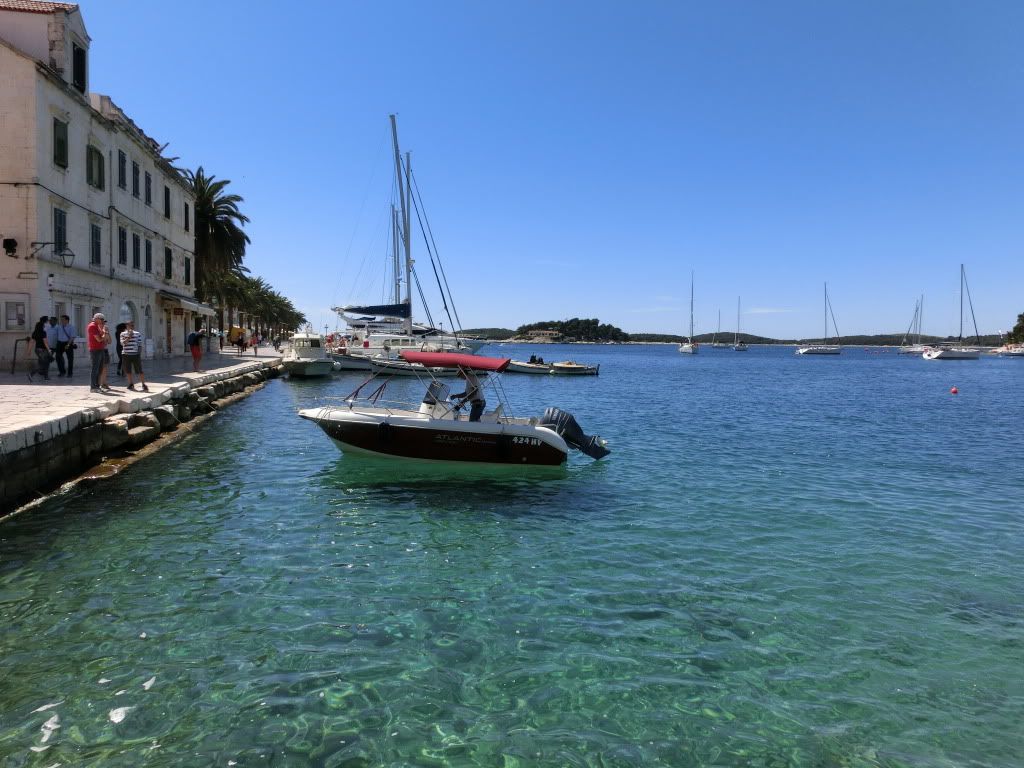 |
| my ride to the pakleni islands |
Saturday, December 8, 2012
Selous - East Africa (D1/2)
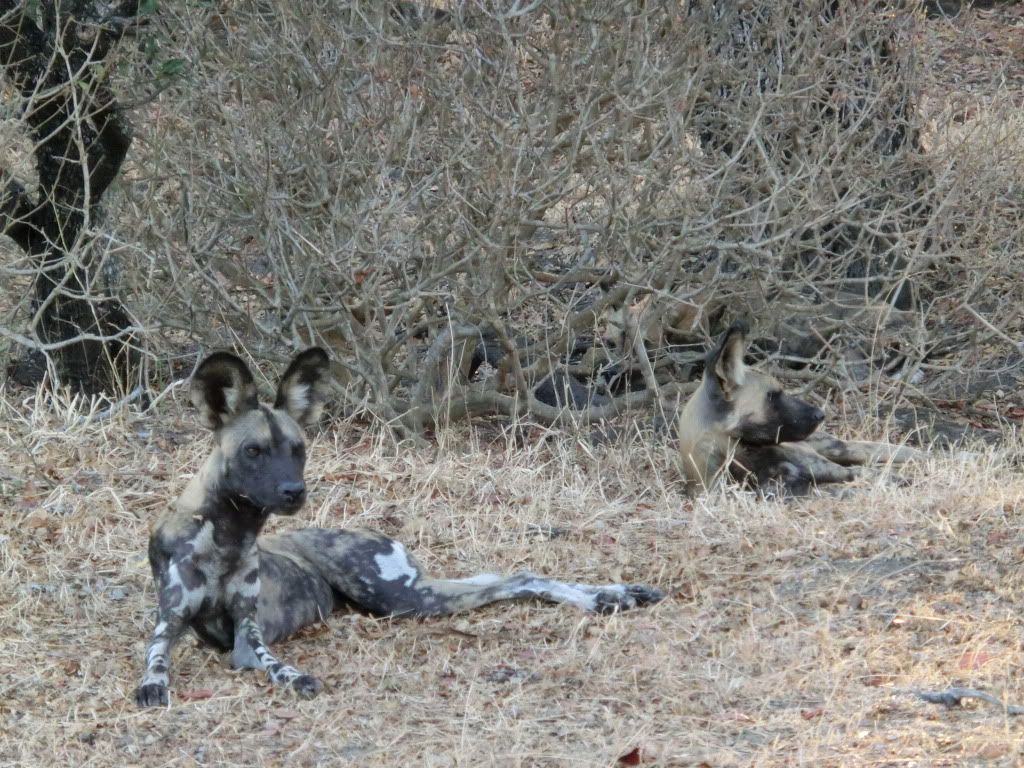
The familiar scent of game parks greeted me as I took a deep breathe while settling in on the jeep that was waiting for me at the airstrip. No matter it took 20 hours - including a grueling 4 hour plus wait at the tiny Dar Es Salaam safari airport and a light aircraft flight from there into the reserve - of travel time to the Selous Game Reserve, when the guide asked if I would like to do a game drive before heading back to camp, I enthused, 'Absolutely!' Covering a staggering 55,000 sq km, the Selous Game Reserve in southern Tanzania is one of the largest game reserves of the world. Most of the reserve remains set aside for game hunting and only a section of the northern park along the Rufiji River has been designated a safari activity zone. Spotting several giraffes near the airstrip, the guide told me that prior to my flight landing, they had to chase them off the airstrip to prevent an accident. Now that is what I call great personalized service. And before I could contain my excitement of finally being there and doing the first game drive (a favorite activity of mine) in 3 years, I saw the one animal that I wished to see most here in Selous - the critically endangered African wild dog or hunting dog. There were once approximately 500,000 African wild dogs and packs of 100 or more were not uncommon. Today there may be as few as 4,000 and they are primarily found in eastern and southern Africa, mostly in the two remaining large populations found here in Selous and the Okavango Delta in northern Botswana. There were several pups resting around the trees and a couple of adult dogs (probably 'baby sitters' as the rest could be out hunting) nearby... top of my wishlist checked, this was shaping up to be a great safari trip.

The motorboat safari in Lake Manze is excellent for birding and getting up close to some animals like the hippos and crocodiles and it can also add variation to the game viewing activities. My late morning boat safari brought me my first sightings of birds like the Egyptian geese, intermediate egret and many more than I could remember. The lake side was teeming with animals like waterbucks, buffaloes, giraffes and elephants while the two most abundantly animals seen in the lake were crocodiles and hippos. The crocodiles were mostly small to medium sized (rarely longer than 2m) and I reckoned the hippos posed a greater threat with plenty of them appearing larger and heavier than the motor boat. Our boat glided pass barely two meters from a group of hippos as my boatman gave me a somewhat reassuring smile. What the hell was this guy doing! But there were just so many hippos in the lake and I began to loosen up after several more close encounters with these big fellas. I thought the exhilarating boat safari was hard to beat but the afternoon game drive was quite amazing too though in a different way. Late on in the game drive, it started with just two adolescent lions - a male and a female walking pass our stationary jeep, then out of nowhere another appeared and then another and soon there were 6 or 7 of them. We followed them to a waterhole and observed closely lions social behavior - drinking, playing (among the adolescences) and greeting one another by rubbing their cheeks and necks together. There were about eight in total, at least three of which were adolescent male. I have no idea how long we stayed to watch them for and we left as the sun set and one by one the lions moved away into the bush. On the way back to camp, we saw the same pack of African wild dogs from the day before. Again only the pups and a couple of 'baby sitters' were there and I noticed one of them was limping slightly. It was a moment to savor, knowing that this could be the last time I see them again on this trip.... as it turned out it was.
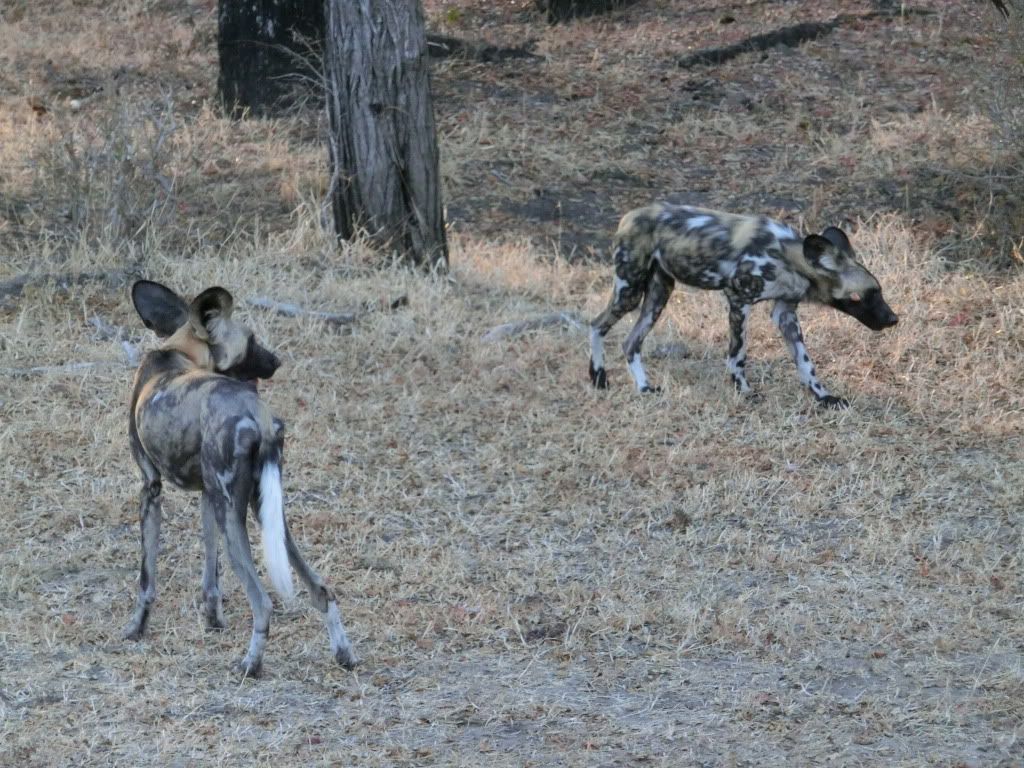 |
| african wild dogs or hunting dogs |
Wednesday, September 26, 2012
Retreat to Vis - The Balkans (D6/7)
I like a change of pace as I travel so I would, where possible, include some less-trodden or low-key places and while in the Balkans, that retreat came in the shape of the island of Vis. The furthest of the main central Dalmatian island from the coast, Vis served as a military base and was closed to visitors until 1989. The isolation preserved the island from development and drove much of the population away, leaving it underpopulated for many years. I rented an apartment from a lady who meet newly arrivals at the port. It was a great place at a great price - a minute walk from the port, adequately equipped and furnished and a spacious balcony with a splendid sea, port and Vis town view. It was easily my favorite accommodation choice of the trip. I spent the rest of the afternoon lazing off a nearby beach. The water was still cold but that did not stop me from taking quick dips. That evening, I walked along the scenic harbor side promenade to Kut for dinner. It seemed like everyone recommended this restaurant but I found it to a bit pricey and the portion small. The quality of the service and food was good though. I had the grilled squid, scorpion fish and local white wine.
After a hearty buffet breakfast at what seemed to me like the only hotel in Vis Town, I paid another visit to the medieval neighborhood of Kut. I did not linger for long as I had arranged for a car with driver for a late morning pickup to travel to various parts of the island. First stop was the town of Komiža on the western coast. Komiža is a small pleasant fishing town on a bay with a bohemian feel about it. We drove up to the hills for a stupendous view of Komiža and the coastline before heading off to the beach. It would be a shame to leave Vis without visiting one of its fabulous beaches and there are actually quite a few to choose from. My choice was the Srebrna or silver beach situated on the south-eastern side of the island. Srebrna is an astoundingly beautiful pebble beach with unusual, large pebbles that glare under the sun. It was nice and quiet, the way that I like it but the water was too cold for a swim. A short stay later, it was off to lunch at a konoba that specializes in peka cooking about 4 km outside Vis town. Peka is a cast-iron dome, placed over coals, which they use to slow-roast octopus (or kid lamb). It comes with potatoes, optionally carrot is added. My pre-ordered peka octopus was so tender and stickily caramelized melting in the mouth... divine. Back in Vis town in the mid afternoon and decided that it would be a great idea to walk off the incredible meal to nearby George III Fortress. After some uphill walking, I realized that I had missed the turn to the fortress and ended up at the rogacica instead. To get to the ruins, there was a thorny scrubs covered slope to overcome but the view was certainly worth all the nicks on the shins and effort.
 |
| peka octopus - simply the best |
Saturday, August 11, 2012
A Tale of Two Cities - The Balkans (D4/5/6)
In the historic town of Zadar, I found myself in a dormitory full of strangers. A hostel dorm is not my top choice of accommodation these days but a combination of events and the lack of other options in the old town led to this. It was another late arrival and upon freshening up, it was time for dinner and I had an excellent seafood platter and local white wine at a konoba (local eatery). After the best meal of the trip so far, I walked it off to the harbor front to see and hear two unique features of Zadar - the Sea Organ and Sun Salutation. The incredible Sea Organ, designed by local architect Nikola Bašić, is an ingenious idea. It is set within the perforated stone stairs that descend into the sea with a system of pipes and whistles that exudes wistful sighs when the movement of sea pushes air through it. The result is hypnotic tones increasing in volume when a boat or ferry passes by. Right next to it is the Sun Salutation, another wonderful wacky Bašić creation. It is a 22m circle solar energy system that cut into the pavement and together with the wave energy that makes the Sea Organ's sound, produce a psychedelic light show from sunset to sunrise that is meant to simulate the solar system. The old town is just filled with Roman remains and some can be found in rather unexpected places. It is interesting how some of them have blended into the new buildings and environment. My favorite feature is when the ruins are actually functional, like how an old Roman wall with a gate added to it, is used to seal off a property.
As with most travelers to the southern Dalmatia, I used Split as a transportation base and at first did not think of it as an attraction per se. That notion changed shortly after I arrived. I got a nice room from a lady at the bus station and as we were walking back to her property along the busy Diocletian Palace waterfront, I immediately felt the exuberance mood of the city. That evening, a local folk dance, music and song performance was staged at the waterfront. Apparently, I had stumbled upon a regional celebration or event that I did not know about and it was fun and entertaining. Within the palace walls, a bar creatively turned the open courtyard next to the Diocletian Mausoleum and Sveti Duje Cathedral into a cool open air music lounge complete with candles, cushions and live music performance. The sound of opera singing led me to yet another fine performance a few twists and turns along an alley away. Like the old town Zadar, I find it intriguing the way section of the remains of Diocletian Palace appeared side by side with the new buildings. Some of the buildings are simply built fused to the ruins so you get a mixed of something old and something new within a complex.
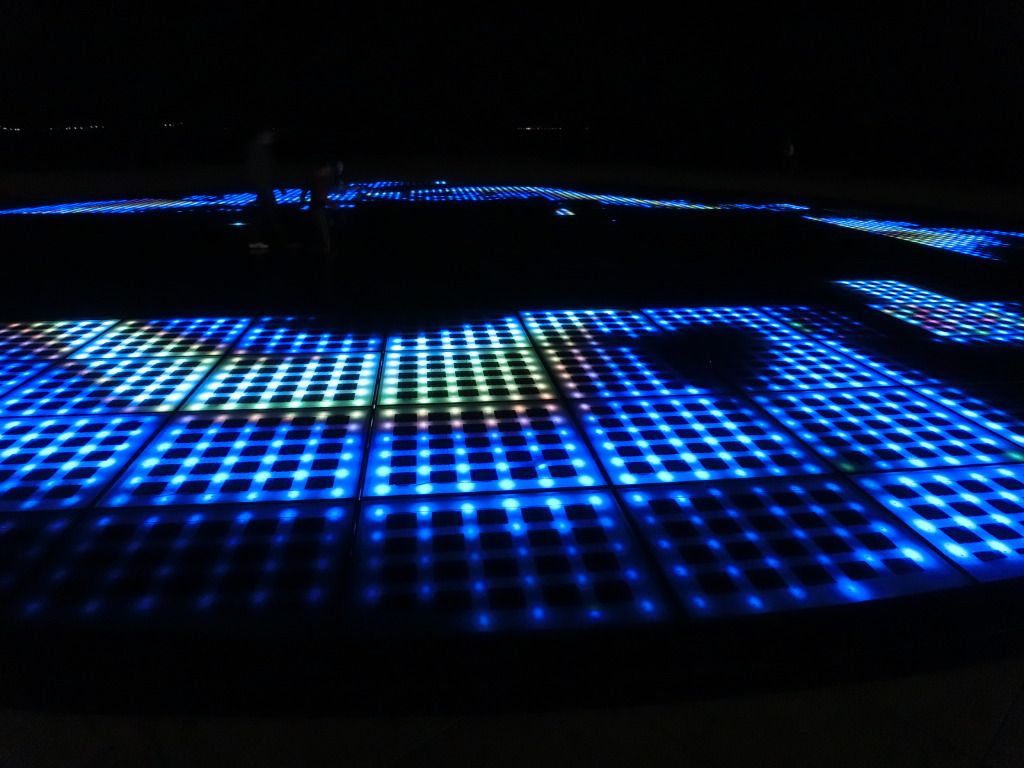 |
| psychedelic light show |
Saturday, July 7, 2012
Natural Wonderland - The Balkans (D3/4)
It was late afternoon by the time I settled in at the hotel in Plitvice Lakes but I wanted to visit the lakes late in the day anyway to avoid the crowd so the slight delay did not really upset my plan. Set in a lush valley, Plitvice is a series of terrace lakes, interlinked by waterfalls with miles of pleasant path and plank walks. With countless cascades and lakes that change colors constantly depending on the quantity of the minerals or organisms in the water, rainfall and the angle of the sunlight, it is indeed a natural wonderland. Many people do a day trip to the lakes but because I would rather visit late in the day and again early in the morning when there are fewer tourists, I stayed at one of the two state-run hotels minutes away from the Entrance 1. The hotel decor is dated and dull but it is comfortable and convenient plus I got a room with a good view of the lakes. The weather though was less than perfect and I found myself in a limbo at the entrance as to whether to run back to grab my poncho. Finally I got my rain gear on and started the trek along Kozjak Lake. Kozjak is the largest lake in the park surrounded by steep, forested slopes with good path that runs along to the Lower Lakes. After 40 minutes or so of walking, passing some amazing scenery of forests, steep cliffs and waterfalls, I got to the Gavanovac Lake. Above here is the open-topped cavern of Supljara, where there is a lovely viewpoint over the Lower Lakes. The image of Gavanovac with its wooden walkway that cuts across to the north bank is commonly seen on postcards, magazines and books on Plitvice. In fact, it was this very image that caught my eye some years ago as I went, 'Hey, I'd like to go there some day.'
Early next morning, I took a ferry to the Upper Lakes and started to hike from there. Along the Gradinsko, the sight of powerful waterfalls from the nearby Okrugljak lake and its reflection in the water was quite amazing. A series of cascades links Gradinsko to beautiful Galovac Lake, where an abundance of water has formed a series of ponds and falls. Moving on to the Okrugljak, I came face to face with the waterfalls I saw back at Gradinsko - I think they are the tallest that I have seen in Plitvice. The Upper Lakes are surrounded by dense forests and some of the lakes and ponds are smaller and all laced together by gushing falls. There are countless waterfalls in Plitvice and in the Upper Lakes, they are bigger, more spectacular and you can get closer to them. I definitely find the Upper Lakes more alluring. The lakes have the soothing and peaceful effect on me, especially on an overcast day but that is only when you avoid the international tour groups. It took about 90 minutes to complete my Upper Lakes circuit and from the jetty, I sailed along Kozjak on a one-way ferry to the Lower Lakes. From there, it was kind of touch and go, taking the park trolley bus back to Entrance 1 as there was a strict requirement by the hotel to check out by 12 noon.
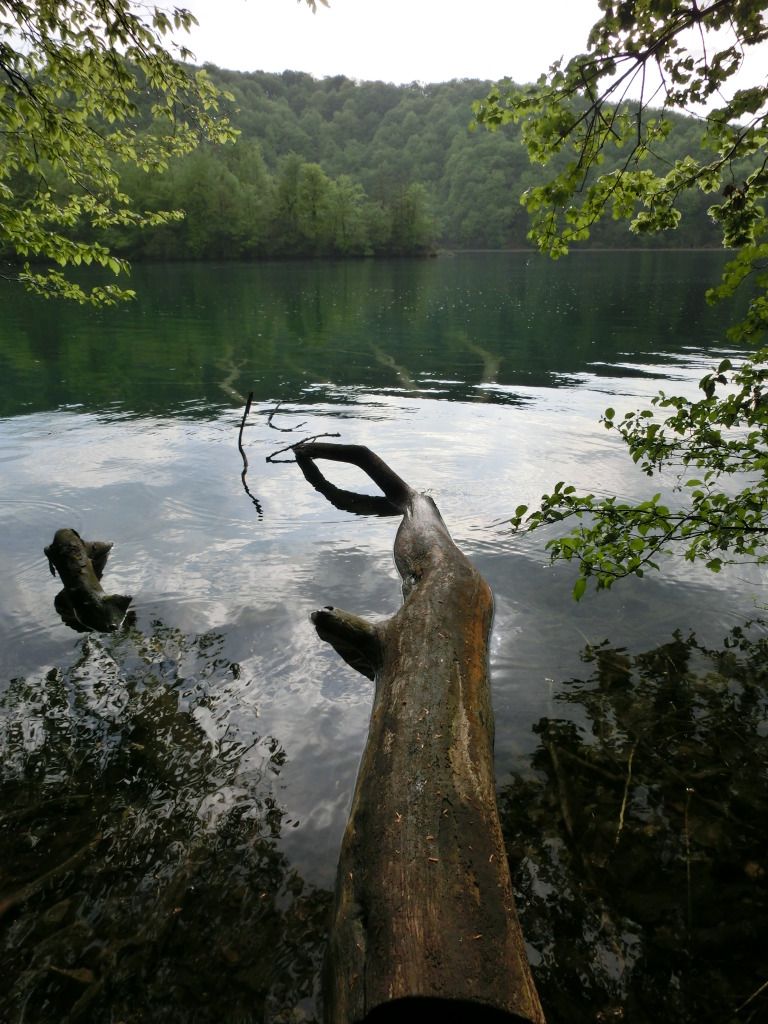 |
| isn't it lovely? |
Sunday, June 3, 2012
A Good Place To Start - The Balkans (D1/2)
In my recently concluded trip to the Balkans, I could not have done much better than starting at Zagreb. After a long flight, I really appreciated a low-key, relax and most of all, a European city not overrun by tourists. Do not get me wrong, Zagreb is anything but boring and there are actually plenty to see and do here. The first thing that greeted me though was the heatwave as it was unseasonably warm here on the last day of April. I rented a room near the bus station which in certain cities mean undesirable or unsafe location. But the neighborhood is really nice, pleasant and about 15 minutes walk to the Upper Town. Walking to the center for the first time, with the quiet streets and closed shops in the mid afternoon, I could hardly believe that I was in the capital and biggest city of Croatia. Things though were a lot livelier in the center. Trg Josipa Jelacica, the main orientation point and heart of the city is a good place to people watch as tram-loads of people get out, greet each other and disperse. Though a bit tired by then, I ventured on to the Kaptol Square. It is dominated by the 13th century Cathedral of the Assumption of the Blessed Virgin Mary (formerly known as St Stephen's). Nice but one of its twin spires was under construction. I settled for dinner at a beer garden style place near my apartment building. It was the worst meal of the trip. Why is it that the first meal on the road is seldom good?
It was a Sunday and the local market next to the apartment building was closed so my plan to have a local breakfast there was off. There was not much option on the way to the center either and I was getting the impression that maybe breakfast is not a big thing here. By late morning, I finally decided to just buy a sandwich from a stand in Trg Josipa Jelacica. After my less than satisfying brunch, I began my walking tour of the Upper Town. All of the buildings here were restored or rebuilt after a massive earthquake of 1880. They now house the political and cultural centers of the country. Some of the ancient palaces have been converted into museums. There are several churches in the old town and the most notable one must be the Church of St Mark with its colored glazed tiles roof bear the coats of arms of Croatia, Dalmatia, Slavonia and Zagreb. The Dolac Market which borders between the Upper and Lower Towns was also closed that day. Back at the Lower Town, along the series of parks and open spaces, people were having picnics and other outdoor activities. The major museums are all located here and it is such a nice area to have a stroll. Dinner was pit roasted kid goat and grilled trout with almond at a restaurant near the parks. I also sampled some Croatian red wine for the first time .... the first decent meal of the trip.
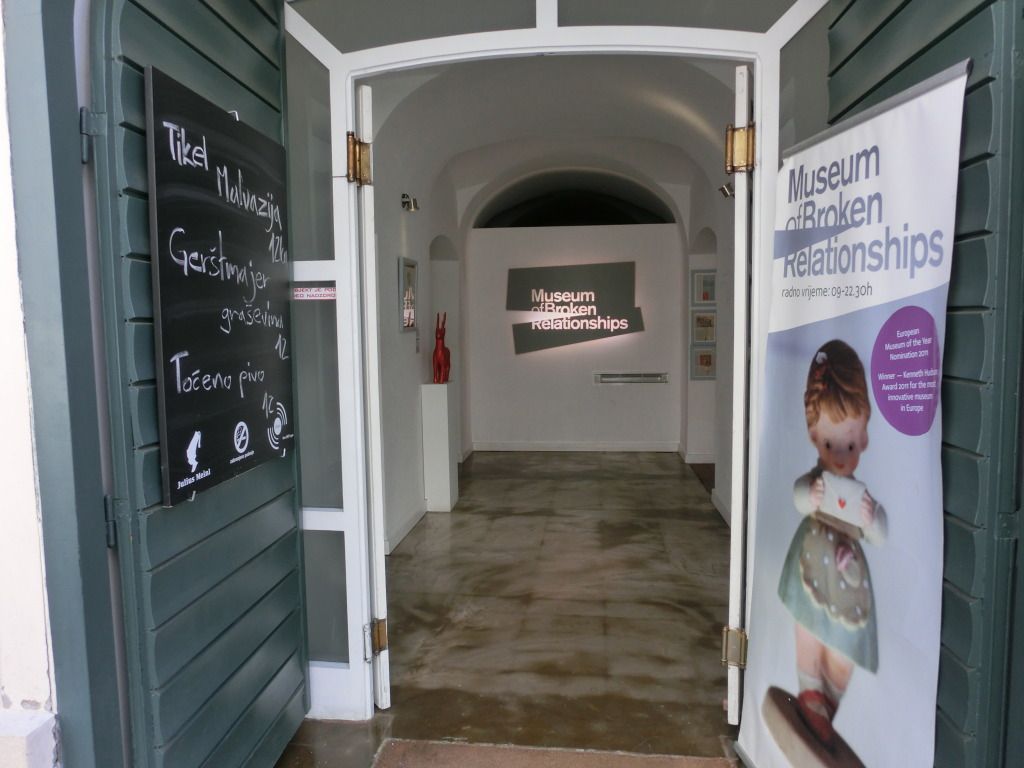 |
| quirky museum in upper town |
Subscribe to:
Posts (Atom)
